
Introduction
The Supreme Court of India has issued important directions aimed at improving the handling of dowry-related criminal cases and reducing delays in matrimonial litigation involving allegations of cruelty and dowry harassment.
In State of Uttar Pradesh v. Ajmal Beg, the Court highlighted concerns surrounding the implementation of dowry laws and the prolonged pendency of criminal proceedings. The subsequent directions focus on expediting trials, reducing unnecessary adjournments, strengthening digital monitoring and encouraging mediation or counselling in appropriate matrimonial disputes.
These directions are particularly relevant to cases involving Section 498A of the Indian Penal Code (IPC), Section 304B IPC and their corresponding provisions under the Bharatiya Nyaya Sanhita (BNS).
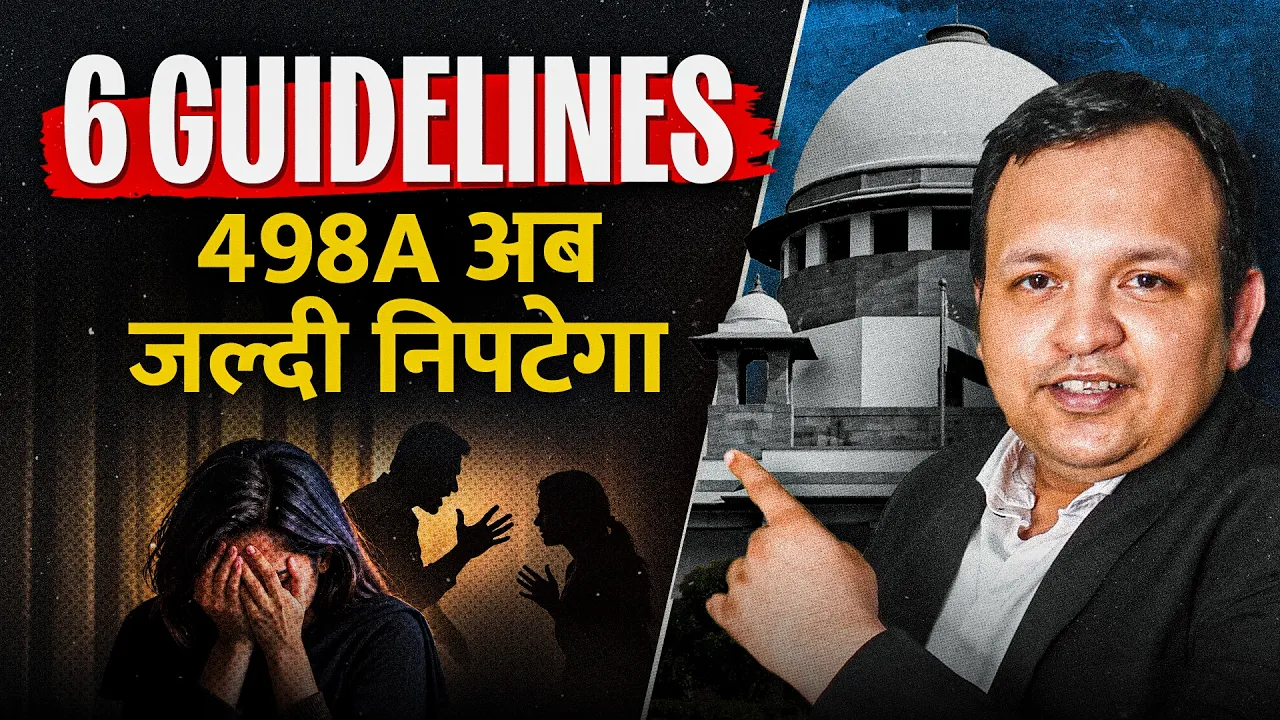
In this article, we explain the six important guidelines discussed in the video and what they may mean for people involved in pending matrimonial and dowry-related cases.
Case Background: State of Uttar Pradesh v. Ajmal Beg
The case arose from allegations of dowry demands and harassment of a married woman. The allegations included demands for a colour television, a motorcycle and ₹15,000.
The trial court convicted the husband, Ajmal Beg, and his mother under Sections 498A and 304B IPC and Sections 3 and 4 of the Dowry Prohibition Act, 1961. The Allahabad High Court subsequently set aside the convictions.
The matter reached the Supreme Court, which delivered its judgment on 15 December 2025, allowing the State’s appeals and restoring the trial court’s convictions.
The case also drew attention to the long delays that can affect dowry-related criminal proceedings. The Supreme Court subsequently issued further directions on 20 August 2026 to improve case management and the handling of pending matters.
Six Important Supreme Court Guidelines on 498A and Dowry Cases
1. Fast-Track Justice in Dowry-Related Cases
The Supreme Court directed that cases involving offences such as dowry death and cruelty against married women should, as far as practicable, receive priority and be disposed of expeditiously.
The objective is to prevent criminal proceedings from remaining pending for years without meaningful progress. The Court also emphasised identifying older cases, particularly those that have been pending for more than three years and are awaiting the framing of charges or the recording of evidence.
Why it matters: Faster proceedings can reduce prolonged uncertainty and stress for complainants, accused persons and their families. However, prioritising these cases does not mean bypassing due process or compromising a fair trial.
2. Charge Framing Within 60–90 Days
The Supreme Court stated that trial courts should endeavour to frame charges preferably within 60 to 90 days from the filing of the chargesheet, subject to applicable procedural safeguards.
This direction is intended to help criminal proceedings move forward instead of remaining stuck at the initial stages for an extended period.
It is important to understand that the 60–90-day period is a directory benchmark, not an absolute deadline or a guarantee that charges will be framed in every case within that period. Factors such as multiple accused persons, supplementary chargesheets, forensic delays or the unavailability of an accused may justify a departure from the timeline.
Why it matters: The direction encourages courts to address avoidable delays at the charge-framing stage while preserving the procedural rights of everyone involved.
3. No Unnecessary Adjournments
The Supreme Court emphasised that unnecessary adjournments should be discouraged and that reasons for granting adjournments should be recorded.
Repeated postponements can delay witness examination, prolong litigation and make it harder for cases to reach a conclusion. The Court also addressed situations in which an accused person’s lawyer repeatedly remains absent without sufficient cause, noting that appropriate steps, including legal aid arrangements, may be considered in accordance with law.
Why it matters: Better control over adjournments can help maintain continuity in trials and reduce avoidable delays. At the same time, reasonable adjournments may still be necessary to protect the parties’ rights and ensure a fair hearing.
4. Digital Dashboard Monitoring
The Supreme Court called for greater use of digital systems and court dashboards to monitor the progress of pending cases.
Digital monitoring can help authorities identify cases that have remained at a particular stage for too long, track case pendency and support timely administrative intervention.
Court information systems may also help generate alerts and provide a clearer picture of the progress of cases across different stages of criminal proceedings.
Why it matters: Digital monitoring can make delays easier to identify and address. However, a dashboard does not itself decide a case or guarantee a particular outcome; effective implementation and judicial action remain essential.
5. High Courts to Review Pending Matters
The Supreme Court called upon High Courts to undertake periodic reviews of older criminal matters, including appeals, revisions, petitions seeking relief under Section 482 of the Code of Criminal Procedure or Section 528 of the Bharatiya Nagarik Suraksha Sanhita, and bail matters.
Particular attention was drawn to cases in which trial proceedings have been stayed or have remained pending for an extended period.
The directions also envisage the use of case data and periodic reviews to identify matters requiring attention.
Why it matters: Regular monitoring by High Courts can help identify procedural bottlenecks and long-pending matters. It may support more efficient case management, although the result and timeline of an individual proceeding will depend on its facts and applicable law.
6. Promote Mediation and Counselling in Appropriate Cases
The Supreme Court observed that mediation and counselling may be explored in suitable matrimonial disputes primarily arising from matrimonial discord, where such an approach is legally permissible and appropriate.
This is not a direction to send every 498A case for mediation. The Court’s observation excludes an indiscriminate approach to matters involving death, grievous physical violence or other serious offences. Mediation must not undermine the rights of the parties or minimise the seriousness of cognisable offences.
Where legally appropriate, mediation or counselling may help parties explore a mutually acceptable resolution to matrimonial disputes.
Why it matters: Mediation may be useful in suitable disputes, but it is not a substitute for criminal proceedings where the law requires them to continue. Whether mediation is appropriate must be assessed in the context of the allegations, applicable law and circumstances of the case.
What Should You Do If Your 498A Case Is Pending?
The Supreme Court’s directions focus on timely proceedings, better monitoring and reducing avoidable procedural delays. If you are involved in a pending 498A or dowry-related case, understanding the current stage of the proceedings is a useful starting point.
First, check whether the chargesheet has been filed, whether the court has considered the framing of charges, and whether evidence has started. The stage of the case will help determine what procedural steps may be available and whether there has been an avoidable delay.
Second, maintain copies of relevant court orders, filings, notices and other case documents. Keeping these records organised can help you and your lawyer assess the history of the proceedings and identify any issues that need attention.
If your case has remained pending for a long period, discuss the reasons for the delay with your lawyer. Depending on the circumstances, your lawyer can advise whether an appropriate application, request for an early hearing or other procedural remedy is available. The correct course of action will depend on the facts and the stage of the proceedings.
Finally, do not assume that these guidelines automatically result in the quashing of a case, establish that a complaint is false, or guarantee that every trial will be completed within 90 days. The directions are intended to improve the handling of cases, while individual matters continue to be decided according to the evidence and applicable law.
What These Guidelines Mean for Husbands and Wives
The six guidelines are directed towards improving the functioning of the justice system in dowry-related criminal cases. Their practical impact may be felt by complainants, accused persons and their families, although the effect will depend on the circumstances of each case.
For women facing dowry harassment, the emphasis on timely proceedings and effective institutional support highlights the importance of accessible remedies and appropriate handling of complaints. For accused persons and their families, improved monitoring and fewer unnecessary adjournments may help reduce avoidable delays and prolonged uncertainty.
For both parties, an important principle remains unchanged: criminal proceedings must be conducted fairly, with due regard to the evidence, the applicable law and the rights of everyone involved. Faster proceedings should not mean rushed decisions, and procedural safeguards should not become a reason for avoidable delay.
The directions also highlight that improving the administration of justice requires more than judicial orders alone. Effective implementation by trial courts, High Courts and relevant authorities will be important in translating these directions into meaningful improvements.
Conclusion
The Supreme Court’s directions in State of Uttar Pradesh v. Ajmal Beg emphasise faster case progression, timely framing of charges, fewer unnecessary adjournments, digital monitoring, review of pending matters by High Courts and mediation or counselling in suitable disputes.
The practical impact will depend on how courts and the relevant authorities implement these directions. For anyone involved in a pending 498A or dowry-related case, understanding the current stage of the proceedings and obtaining case-specific legal guidance remain important.
Frequently Asked Questions (FAQs)
1. What are the six Supreme Court guidelines on 498A and dowry cases?
The six guidelines discussed in this article concern fast-tracking dowry-related cases, framing charges preferably within 60–90 days of filing the chargesheet, discouraging unnecessary adjournments, monitoring cases through digital dashboards, reviewing pending matters through High Courts, and promoting mediation or counselling in appropriate matrimonial disputes.
2. Is it mandatory to frame charges within 90 days in every 498A case?
No. The Supreme Court has stated that trial courts should endeavour to frame charges preferably within 60–90 days from the filing of the chargesheet, subject to applicable procedural safeguards. This is a directory benchmark, not an absolute deadline applicable without exception.
3. Do the Supreme Court’s guidelines apply to pending 498A cases?
The directions aim to improve the handling and timely progress of relevant criminal proceedings, including older pending cases. Courts are expected to identify long-pending matters and take appropriate steps to reduce avoidable delays, subject to the circumstances of each case and the applicable law.
4. Can a 498A case be dismissed if the trial is delayed?
A case is not automatically dismissed merely because the trial has been delayed. Whether an accused person can seek relief depends on the facts, the nature and extent of the delay, the applicable law and the court’s assessment. A person facing prolonged proceedings should consult a lawyer about the remedies available in their particular case.
5. What does the Supreme Court say about unnecessary adjournments?
The Court has emphasised that unnecessary adjournments should be discouraged and that reasons for granting adjournments should be recorded. The objective is to prevent avoidable delays while ensuring that both sides receive a fair opportunity to present their cases.
6. Does the Supreme Court require every 498A case to go to mediation?
No. Mediation and counselling may be explored in appropriate matrimonial disputes where legally permissible. This is not a blanket direction for every 498A case, particularly those involving death, grievous physical violence or other serious offences. Mediation must not compromise the rights of the parties or bypass applicable criminal law.
7. How will digital dashboard monitoring help in pending dowry cases?
Digital monitoring can help judicial authorities track case progress, identify matters that have remained pending at a particular stage and review older cases. However, monitoring alone does not guarantee faster disposal; effective action by the relevant courts and authorities remains necessary.
8. What should a person do if their 498A case has been pending for years?
The person should check the current stage of the proceedings, maintain relevant court documents and discuss the reasons for the delay with their lawyer. Depending on the circumstances, an application for an early hearing or another appropriate procedural remedy may be considered.
9. Which legal provisions are relevant to dowry harassment and dowry death cases?
Section 498A IPC dealt with cruelty by a husband or his relatives, while Section 304B IPC deals with dowry death. Their corresponding provisions under the Bharatiya Nyaya Sanhita, 2023, are Sections 85 and 80, respectively. Section 86 BNS defines cruelty for the purposes of Section 85. The Dowry Prohibition Act, 1961, also addresses the giving, taking and demanding of dowry.
10. Does the Ajmal Beg judgment automatically quash false 498A cases?
No. The judgment and subsequent directions do not automatically quash cases or establish that a complaint is false. Each matter must be assessed on its own facts, evidence and applicable law. Any request for quashing must be considered by the competent court under the relevant legal principles.
If doubts still persist, contact our Legal Experts at https://thelegalshots.com/legal-opinion