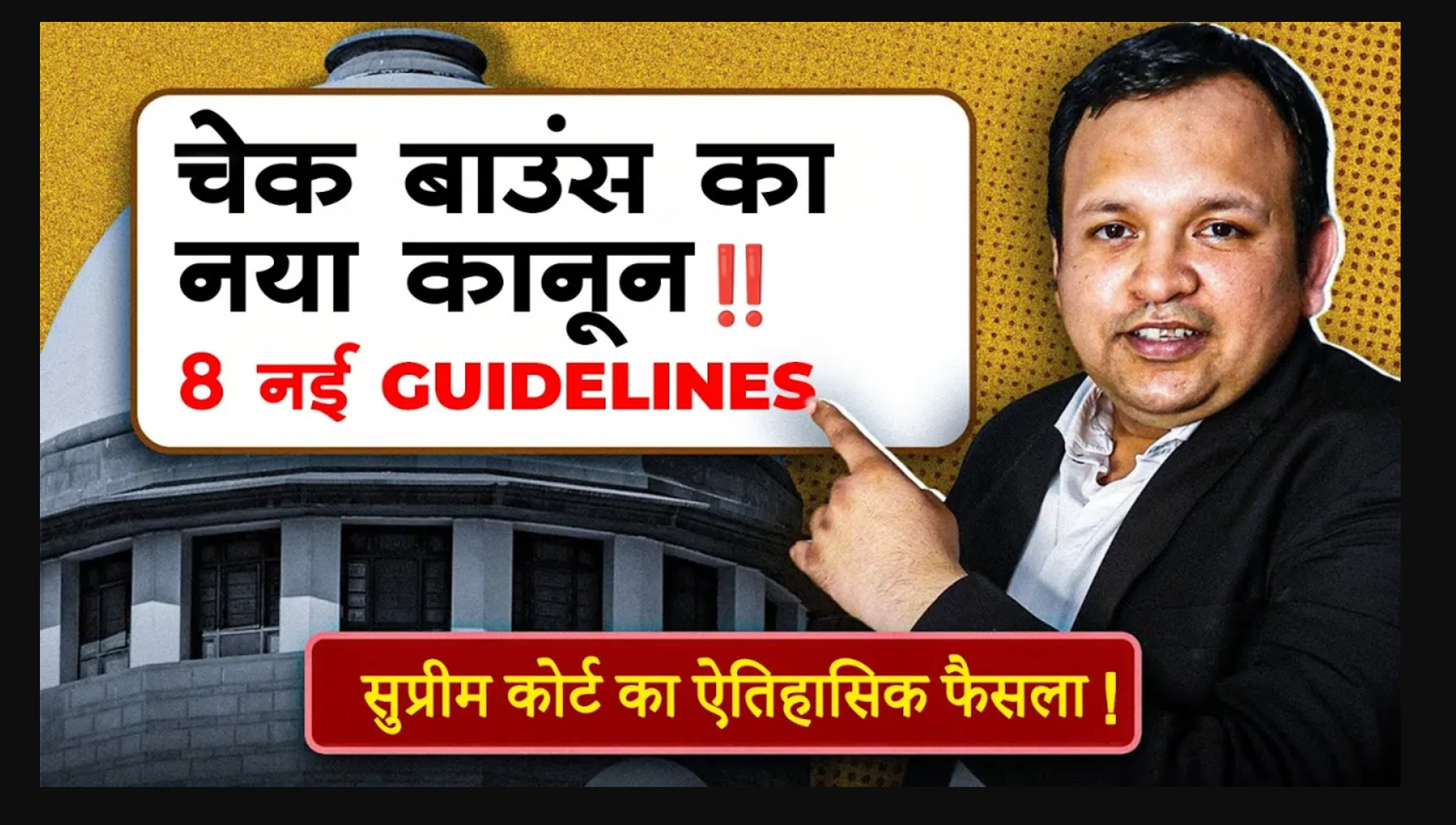
Supreme Court’s Landmark Judgment: 8 New Guidelines to Revolutionize Cheque Bounce Cases Under Section 138 NI Act
Introduction
In a significant move to unclog the judicial backlog and restore faith in the cheque as a reliable financial instrument, the Supreme Court of India has issued eight comprehensive guidelines in the case of Sanjabij Tari v. Kishore S. Borcar & Anr. (2025 INSC 1158). Delivered on September 25, 2025, clarifying critical aspects of cheque dishonour prosecutions under the Negotiable Instrument Act 1881 (NI Act). this judgment not only upholds the sanctity of presumptions under the Negotiable Instrument Act but also introduces tech-driven and procedural reforms to expedite the resolution of cheque dishonour cases. With over 3 crore pending cases under Section 138 across district courts, these directives aim to promote early settlements, leverage digital tools, and ensure fair trials making justice swifter and more accessible.
Facts of the Case
The dispute originated from a friendly loan transaction between the appellant-complainant, Sanjabij Tari, and the respondent-accused, Kishore S. Borcar, both are residents of Goa. In 2005, Tari advanced ₹6,00,000 in cash to Borcar, who issued a cheque dated October 31, 2006, for the same amount as repayment of this legally enforceable debt. When Tari presented the cheque for encashment, it was dishonoured due to “insufficient funds” on November 1, 2006. Tari promptly issued a statutory demand notice under Section 138(b) of the NI Act on November 10, 2006, demanding payment within 15 days. Borcar neither replied nor made any payment, prompting Tari to file a private complaint under Section 138 in the Judicial Magistrate First Class Court, Mapusa, Goa. The Trial Court convicted Borcar on April 30, 2007, sentencing him to six months simple imprisonment and directing repayment of the cheque amount in instalments (₹50,000 upfront, balance in six equal monthly instalments). The Sessions Court upheld this conviction on September 17, 2008. However, The Bombay High Court at Goa, in a revision petition, acquitted Borcar ex-parte on April 16, 2009, citing Tari’s alleged lack of financial capacity (monthly income of ₹2,300 and existing debts) and accepting Borcar’s defence that the cheque was issued blank as security for Tari to secure a bank loan without any receipt for the cash advance. Tari appealed to the Supreme Court, arguing that the High Court erred in rebutting the statutory presumptions under Sections 118 and 139 of the NI Act without evidence, and in overturning concurrent findings of fact without perversity. Borcar countered by relying on the Income Tax Act’s restrictions on cash loans and precedents questioning the complainant’s credibility.
Laws Involved :
Negotiable Instruments Act, 1881 (NI Act):
Section 138: Criminalizes dishonour of cheques issued for discharge of a debt or liability, punishable with up to two years’ imprisonment, fine up to twice the cheque amount, or both.
Section 118: Presumption that every negotiable instrument was made/drawn for consideration.
Section 139: Presumption that the holder received the cheque for a legally enforceable debt.
Section 142: Conditions for taking cognizance of offences.
Section 143: Summary trial procedure for expeditious disposal.
Section 143A: Mentions the court’s power to order interim compensation.
Section 147: States that offences under the Act are compoundable.
Income Tax Act, 1961:
Section 269SS: Prohibits cash loans/acceptances exceeding ₹20,000 without banking channels (penalty under Section 271D).
Bharatiya Nagarik Suraksha Sanhita, 2023 (BNSS):
Section 528: The High Court’s inherent powers, which were invoked to recall the ex-parte acquittal order.
Sections 274, 278: Substance of accusation in summon cases, outlines the magistrate’s options for acquittal or conviction after taking evidence in such cases respectively.
Section 223: Cognizance and summons issuance.
Section 530: Electronic service of summons.
Section 64: Service via electronic modes.
Constitution of India,1949:
Article 142: The Supreme Court utilized its extraordinary powers under this Article to issue comprehensive guidelines for expediting the disposal of cheque dishonour cases across the country.
The 8 New Guidelines-A Roadmap for Efficient Justice :
Recognizing the alarming pendency of Section 138 cases, the Supreme Court invoked Article 142 to issue these mandatory, tech-infused guidelines (effective from November 1, 2025). They modify earlier directives from Damodar S. Prabhu v. Sayed Babalal H. (2010) 5 SCC 663, reducing compounding costs to encourage settlements.
1. Multi-Mode Summons Service: In addition to traditional methods, courts must now issue summons via electronic means, including email, SMS, and WhatsApp. The complainant is responsible for providing verified contact details of the accused (supported by an affidavit) and can also serve the summons directly (Dasti service).
2. Mandatory Affidavit of Service: Complainants to file an affidavit confirming service; false affidavits invite perjury action.
3. Online Payment Mechanisms: District courts are directed to create online payment facilities using secure QR codes or UPI links. These links will be mentioned in the summons, allowing the accused to pay the cheque amount online at the initial stage, facilitating quick settlement and case closure.
4. Standardized Complaint Synopsis: Every complaint must prepend a concise synopsis post-index, detailing parties, cheque particulars, dishonour memo, notice, cause of action, relief, and verification streamlining pre-cognizance review.
5. No Pre-Cognizance Summons: Skip summons issuance before cognizance under Section 223 BNSS, as NI Act is a special law prioritizing speed.
6. Structured Initial Hearing and Trial Mode Decision: Courts are strongly encouraged to use summary trial procedures and high courts must consider establishing specialized fast-track benches for these cases to ensure disposal within an estimated 90 days.
7. Timely Interim Relief and Personal Appearance: Direct interim deposits under Section 143A NI Act early. Mandate physical hearings post-summons for direct dialogue; virtual only for pre-summons. Limit appearance exemptions.
8. Monitoring: Orders the creation of dedicated dashboard high- pendency cities for monthly monitoring of case disposal rates by District Judge.
These guidelines emphasize digital justice, victim protection, and backlog reduction, aligning with the NI Act’s 1988 amendments to deter cheque misuse.
Landmark Judgments :
- Bir Singh v. Mukesh Kumar (2019): Limits high courts revisional jurisdiction
- Damodar S. Prabhu v. Sayed Babalal H (2010): Framework for compounding section 138 offences; inform the revised compounding costs to encourage settlements.
- P. Mohanraj v. Shah brothers Ispat Pvt. Ltd. (2021): Views Section 138 proceedings as quasi-civil.
Key Takeaways :
- Reinforced Presumptions: The statutory presumptions of debt/liability (Section 118 and 139) are mandatory upon admission of the cheque signature, placing a heavy burden on the accused to rebut with cogent evidence, not mere doubt.
- Cash Loan Enforceability: Violation of the IT Act’s ₹20,000 cash limit (Section 269SS) does not render the underlying debt void or enforceable under the NI Act; the consequence is only an IT penalty.
- Limit on Revisional Jurisdiction: High Courts are barred from re-appreciating evidence or interfering with concurrent factual findings unless they are manifestly perverse.
- Early Settlement Push: Revised compounding and digital tools aim to slash delays, promoting NI Act as a swift recovery mechanism.
My Personal Opinion
In my view, this judgment is a masterpiece of judicial pragmatism. It tackles the dual problem of the NI Act: the weakening of statutory presumptions by lower courts and the sheer volume of cases caused by procedural delays. The Sanjabij Tari judgment marks a pivotal moment. It is the supreme court’s answer to the decades-long crisis of cheque bounce.
Conclusion
The Sanjabij Tari judgment reaffirms that Section 138 is not a mere civil recovery tool but a robust quasi-criminal safeguard for trade and commerce, where presumptions under Sections 118 and 139 hold unless rebutted by preponderance of probabilities. The Supreme Court allowed the appeal, set aside the High Court’s acquittal, and restored the lower courts’ conviction directing Borcar to pay ₹7,50,000 (cheque amount plus interest) in 15 monthly instalments of ₹50,000.
For a deeper understanding of the judgment and its implications, watch my detailed analysis on my YouTube channel, legal shots!
If doubts persist, contact our Legal Experts at https://thelegalshots.com/legal-opinion